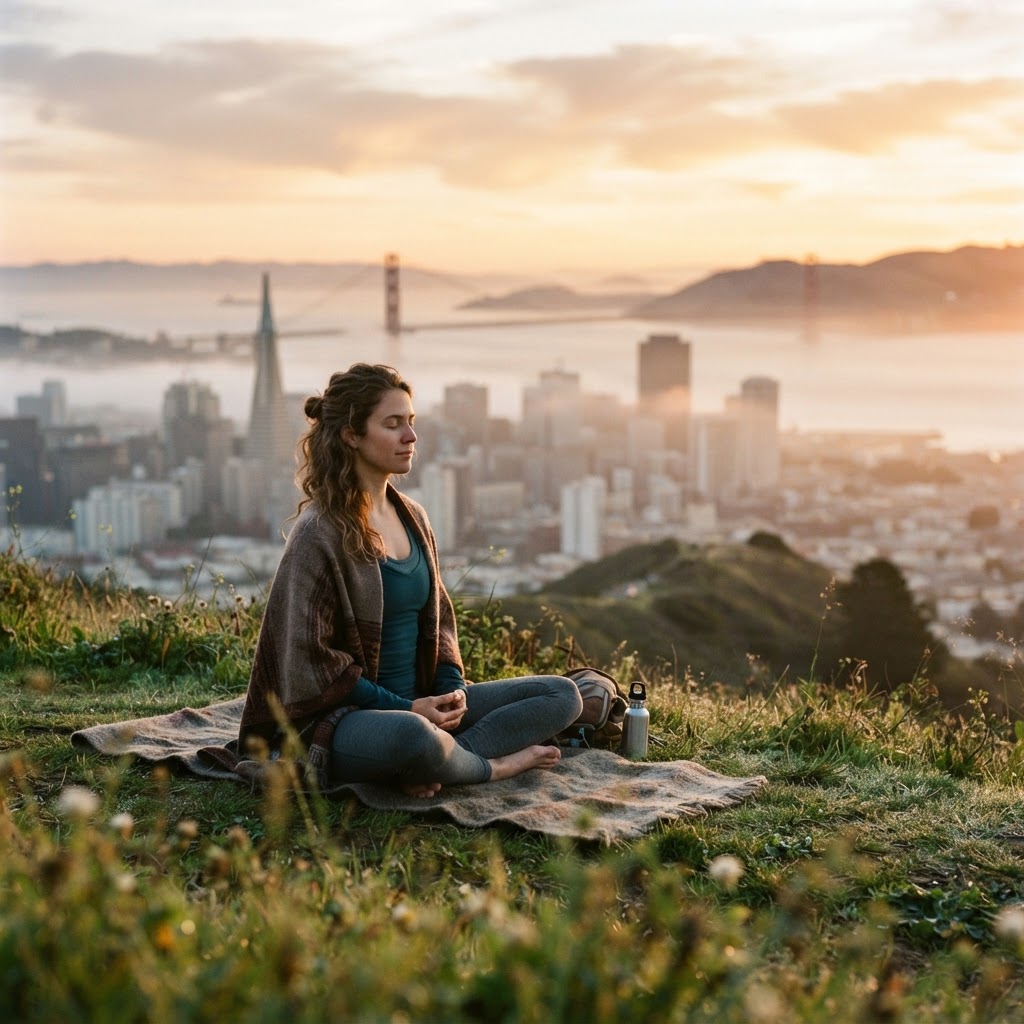
Type "who is the best meditation teacher in San Francisco" into Google and you'll get a long list. Every teacher on it has a beautiful website, glowing reviews, and a strong opinion about their own method. I know, because I'm on that list too.
So let me be honest with you up front: I'm not going to tell you I'm the best meditation teacher in San Francisco. Nobody honest can. Meditation isn't a competition, and the teacher who transforms your life might be someone whose style doesn't work for the person sitting next to you in class.
What I can do is tell you what I've learned in two decades of teaching meditation in this city — from teaching mindfulness to burned-out tech professionals, to leading meditation sessions for SFPD Special Operations officers, to thousands of students who practice with me through Insight Timer and the Calm By Lane podcast. And then I'll answer the question that's probably underneath your search in the first place: how do I actually regulate my nervous system?
The honest answer about "best"
Here's the truth about finding the right meditation teacher: the best meditation teacher is the one whose style you'll actually practice with.
Some people need a teacher with a soft, slow voice. Others connect with someone direct and practical. Some want a spiritual framing; others want neuroscience and protocols. If a teacher's style grates on you, you won't sit down and practice — and an unused perfect teacher helps no one.
When you're evaluating meditation teachers in San Francisco, look for:
- Real student feedback, not just credentials. Read the words students use. Do they describe practical change — sleeping again, feeling calmer at work — or just pleasant sessions?
- Experience with people like you. A teacher who works with first responders and high-stress professionals teaches very differently than one who only works with seasoned meditators.
- A style you'd want in your ears at 6am. You'll hear this person's voice a lot. Chemistry matters.
What my students say (in their words, not mine)
I'd rather let the people I work with answer the "best" question than answer it myself.
Maria E. Garcia, with the San Francisco Police Department's Special Operations Bureau, wrote after our work with Tactical, SWAT and Homeland Security officers:
"Lane has introduced our Special Ops officers to a method of practical and effective stress reduction, allowing these dedicated public servants to be more resilient in their duties. Lane has been a great asset to our team, fun to work with, and a bright spot in the officers' day."
And after meditation sessions with the San Francisco Public Health Laboratory team:
"Your guidance created a calm and supportive space that allowed us to pause, recharge, and reconnect with ourselves amidst our busy work. Many of our employees shared how meaningful the practice was and how they plan to carry forward the techniques you introduced into their daily routines."
Those words mean more to me than any ranking ever could — because they describe outcomes, not polish. Practical stress reduction. People carrying the techniques into their daily routines. That's the whole point.
If that's what you're looking for, start with my free 16-question stress assessment or explore how to practice with me.
Now the real question: how do I regulate my nervous system?
Most people who search for a meditation teacher aren't actually looking for meditation. They're looking for relief. Their chest is tight by 10am, they snap at people they love, they can't sleep, and they've read that "nervous system regulation" is the fix. It is — but it's simpler to start than most articles make it sound.
Your nervous system has two modes that matter: mobilized (sympathetic — heart racing, muscles tense, scanning for problems) and regulated (ventral vagal — you're alert but calm, present, socially engaged). Regulation isn't about forcing calm. It's about giving your body reliable signals that it's safe enough to come out of defense mode.
Here are the five tools I teach almost every client first — the same foundation I'd give an overwhelmed founder or a SWAT officer:
1. The physiological sigh (60 seconds)
Two quick inhales through the nose — a full breath, then a second small sip on top — followed by one long, slow exhale through the mouth. Repeat 2–3 times. This is the fastest known way to downshift your nervous system in real time. Use it before a difficult conversation, in traffic on the Bay Bridge, anywhere.
2. Extended exhale breathing (2 minutes)
Breathe in for a count of 4, out for a count of 6–8. The exhale is what engages your parasympathetic (rest-and-digest) response. Longer exhales than inhales, every time. I teach this in detail in my breathing practice library.
3. Grounding through the senses (3 minutes)
Name 5 things you can see, 4 you can hear, 3 you can touch, 2 you can smell, 1 you can taste. Anxiety lives in the future; your senses live in the present. This pulls your attention back into your body, which is where regulation happens.
4. Morning light and movement (10 minutes)
Get outside within an hour of waking — even a ten-minute walk around the block. Morning light calibrates your circadian rhythm, and gentle movement discharges the stress chemistry your body built up overnight. If you're in San Francisco, this is where a walking meditation practice fits beautifully — Noe Valley, the Embarcadero, the Presidio all work.
5. One consistent daily practice (10–20 minutes)
This is where meditation earns its place. Five minutes of breathwork or a guided Yoga Nidra session every day outperforms an hour-long session once a week, because your nervous system learns through repetition. Consistency is the mechanism — you're literally training your body's default state.
Regulating your nervous system isn't about becoming a different person. It's about your body learning, through small repeated signals, that it doesn't have to live in defense mode.
Where to start this week
Don't try all five at once. Pick one — I'd suggest the physiological sigh, because it works in under a minute — and use it three times a day for a week. Then add the morning walk. Then, when the foundation is set, add a daily guided practice.
If you want guidance, here are your paths with me:
- Start with data: take the free Stress Test to see where your nervous system actually stands.
- Start with practice: join me in the Practice With Me library for guided meditations, Yoga Nidra, and breathwork.
- Start with support: explore working with me one-on-one, or listen free on the Calm By Lane podcast.
And if you're still wondering who the best meditation teacher in San Francisco is — my honest answer is: the one you'll actually practice with, this week, and every week after. I'd be honored if that's me. But either way, start today. Your nervous system is waiting.
Ready to go deeper?
This article is just the beginning. Join Lane live or dive into the full 8-week program to truly transform your stress response and build lasting calm.
Lane Kennedy is a San Francisco meditation teacher and nervous system specialist, author of Sobriety For Dummies (Wiley), and host of the Calm By Lane podcast. She teaches mindfulness, Yoga Nidra, and nervous system regulation to individuals, executives, and first responders. Learn more about her approach here.